curated by Adam Fitzgerald

Wednesday, December 24, 2008

Clock of Secret Weddings

On the side of evil:


Why must I always fall asleep
Why must the night devour me


I am unable to go without a halo
It hurts to be without a crown


But when I sleep soft chimes sound
My indolence hangs on their rope


I dream of the heart of my dead youth.


          *


Then time gives birth to a new order
Order of fall with twisted foliage


I am born I die I open and close the door
I am at the heart of what dies from blooming


I do not know how to leave from where I start off
Nor how to see any part of my sad future


I decorate my sheets with my twisted scowl.


On the side of good:


Over the delicate sky enormous clouds
Broke the flow of monotonous dreams


And when the flaming storm made a face
I was breathing darkness I was taking form


I conceived the earth that I worship
I was like everything that I name


I fortified the forgiving earth.


          *


A thousand songs of grapes and apples
Bedecked all words with fruit


A thousand voyages of animals and men
Sought out the day on the earth without limits


Night kissed the lips of dawn
The flowers were opening under the frantic light


I was radiance I was weakness and strength.


by Paul Éluard (1895 – 1952)
Translated from the French by Lisa Lubasch


Friday, October 19, 2007

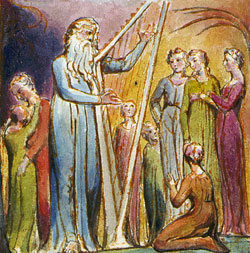
Hear the Voice

Hear the voice of the Bard,
Who present, past, and future, sees;
Whose ears have heard
The Holy Word
That walk'd among the ancient trees;

Calling the lapsèd soul,
And weeping in the evening dew;
That might control
The starry pole,
And fallen, fallen light renew!

'O Earth, O Earth, return!
Arise from out the dewy grass!
Night is worn,
And the morn
Rises from the slumbrous mass.

'Turn away no more;
Why wilt thou turn away?
The starry floor,
The watery shore,
Is given thee till the break of day.'

by William Blake (1757 - 1827)

Thursday, October 18, 2007

To the One of Fictive Music

Sister and mother and diviner love,
And of the sisterhood of the living dead
Most near, most clear, and of the clearest bloom,
And of the fragrant mothers the most dear
And queen, and of diviner love the day
And flame and summer and sweet fire, no thread
Of cloudy silver sprinkles in your gown
Its venom of renown, and on your head
No crown is simpler than the simple hair.

Now, of the music summoned by the birth
That separates us from the wind and sea,
Yet leaves us in them, until earth becomes,
By being so much of the things we are,
Gross effigy and simulacrum, none
Gives motion to perfection more serene
Than yours, out of our own imperfections wrought,
Most rare, or ever of more kindred air
In the laborious weaving that you wear.

For so retentive of themselves are men
That music is intensest which proclaims
The near, the clear, and vaunts the clearest bloom,
And of all the vigils musing the obscure,
That apprehends the most which sees and names,
As in your name, an image that is sure,
Amoung the arrant spices of the sun,
O bough and bush and scented vine, in whom
We give ourselves our likest issuance.

Yet not too like, yet not so like to be
Too near, too clear, saving a little to endow
Our feigning with the strange unlike, whence springs
The difference that heavenly pity brings.
For this, musician, in your girdle fixed
Bear other perfumes. On your pale head wear
A band entwining, set with fatal stones.
Unreal, give back to us what once you gave:
The imagination that we spurned and crave.

by Wallace Stevens (1879 - 1955)

http://salonmedia.vo.llnwd.net/o1/mp3s/stevens1_042202.mp3

Sunday, October 14, 2007

'When love on time and measure makes his ground'

When love on time and measure makes his ground,
Time that must end, though love can never die,
'Tis love betwixt a shadow and a sound,
A love not in the heart but in the eye.
A love that ebbs and flows, now up, now down.
A morning's favour and an evening's frown.

Sweet looks show love, yet they are but as beams,
Fair words seem true, yet they are but as wind.
Eyes shed their tears, yet are but outward streams,
Sighs paint a sadness in the falsest mind.
Looks, words, tears, sighs show love when love they leave;
False hearts can weep, sigh, swear, and yet deceive.

by John Lilliat (1550 - 1599)

Saturday, October 13, 2007

A Far Cry From Africa

A wind is ruffling the tawny pelt
Of Africa, Kikuyu, quick as flies,
Batten upon the bloodstreams of the veldt.
Corpses are scattered through a paradise.
Only the worm, colonel of carrion, cries:
"Waste no compassion on these separate dead!"
Statistics justify and scholars seize
The salients of colonial policy.
What is that to the white child hacked in bed?
To savages, expendable as Jews?
Threshed out by beaters, the long rushes break
In a white dust of ibises whose cries
Have wheeled since civilizations dawn
>From the parched river or beast-teeming plain.
The violence of beast on beast is read
As natural law, but upright man
Seeks his divinity by inflicting pain.
Delirious as these worried beasts, his wars
Dance to the tightened carcass of a drum,
While he calls courage still that native dread
Of the white peace contracted by the dead.

Again brutish necessity wipes its hands
Upon the napkin of a dirty cause, again
A waste of our compassion, as with Spain,
The gorilla wrestles with the superman.
I who am poisoned with the blood of both,
Where shall I turn, divided to the vein?
I who have cursed
The drunken officer of British rule, how choose
Between this Africa and the English tongue I love?
Betray them both, or give back what they give?
How can I face such slaughter and be cool?
How can I turn from Africa and live?

by Derek Walcott (b. 1930)

Friday, October 12, 2007

Sonnet 129

Nuns fret not at their convent's narrow room,
And hermits are contented with their cells,
And students with their pensive citadels;
Maids at the wheel, the weaver at his loom,
Sit blithe and happy; bees that soar for bloom,
High as the highest peak of Furness fells,
Will murmur by the hour in foxglove bells:
In truth the prison unto which we doom
Ourselves no prison is: and hence for me,
In sundry moods, 'twas pastime to be bound
Within the Sonnet's scanty plot of ground;
Pleased if some souls (for such there needs must be)
Who have felt the weight of too much liberty,
Should find brief solace there, as I have found.

by William Wordsworth (1770 - 1850)

Thursday, October 11, 2007

A Book of Music

Coming at an end, the lovers
Are exhausted like two swimmers. Where
Did it end? There is no telling. No love is
Like an ocean with the dizzy procession of the waves' boundaries
From which two can emerge exhausted, nor long goodbye
Like death.
Coming at an end. Rather, I would say, like a length
Of coiled rope
Which does not disguise in the final twists of its lengths
Its endings.
But, you will say, we loved
And some parts of us loved
And the rest of us will remain
Two persons. Yes,
Poetry ends like a rope.

by Jack Spicer (1925 - 1965)